
Dr. Katharina Alter
katharina.alter(at)uni-rostock.de
Tel.: +49 (0) 381 / 498-6066
FORSCHUNGSINTERESSEN
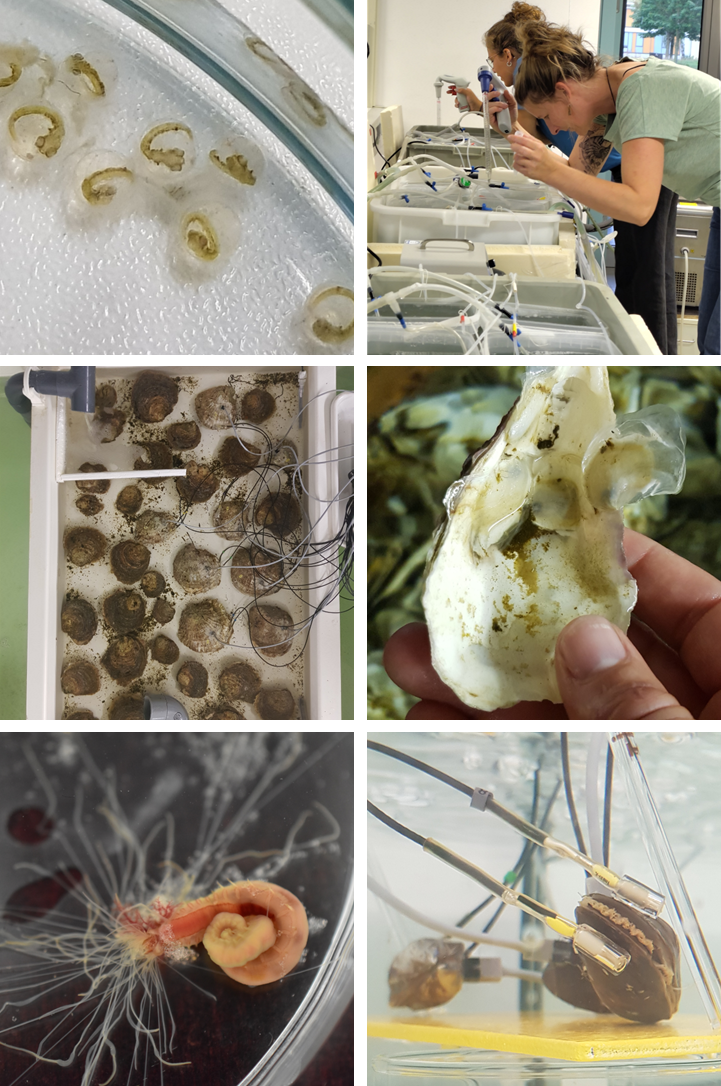
In meinem Team untersuchen wir wie Umweltfaktoren die Physiologie und das Verhalten von Meerestieren niedriger Trophieebenen beeinflussen, dazu gehören Mollusken, Krebstiere, junge Fische und Polychaeten. Mit experimentellen Laborstudien erforschen wir, wie diese Organismen sich an ihre Umgebung anpassen, wie widerstandsfähig sie gegenüber Veränderungen sind und welche Mechanismen ihre Leistungsfähigkeit begrenzen.
Ein Schwerpunkt liegt auf den nahen Auswirkungen des Klimawandels. Dabei betrachten wir nicht nur einzelne Faktoren, sondern kombinieren auch mehrere Umweltparameter wie Temperatur, CO₂ und Sauerstoff, aber auch besonders in der Ostsee wichtige Faktoren wie Nahrungsverfügbarkeit und Salinitätsgradienten, um komplexe Wechselwirkungen zu verstehen. Dabei benutzen wir Methoden wie Sensortechnologie (Sauerstoffverbrauch, Herzraten, Valvometrie), Mikroskopie und Absorptionsspektroskopie, um die Funktionsweise einzelner Zellen bis hin zum Verhalten ganzer Organismen zu verstehen.
Unser Ziel ist es, ein mechanistisches Verständnis dafür zu entwickeln, wie abiotische Faktoren die Leistung und Resilienz von Arten steuern, und daraus Vorhersagen für die Stabilität von Ökosystemen unter sich schnell verändernden Bedingungen abzuleiten.
AKTUELLE PROJEKTE
Hitzestress von Fischembryonen
Energiehaushalt der Miesmuschel entlang Salinitäts- und Temperaturgradienten
MITARBEITENDE
Martha Lewin: Hilfswissenschaftlerin
Paul Schaumburg: Forschungspraktikum mit dem Thema "Auswirkungen von Hitzestress auf Embryonalentwicklung vom Ostseehering"
Salomé Vallo: Bachelorarbeit mit dem Thema "Auswirkungen von Hitzestress auf Embryonalentwicklung vom Hornhecht"
Daphne Rentsch: Bachelorarbeit mit dem Thema “Verbreitung von Amphitoe valida in der Ostsee”
Studierende, die Lust haben, in experimenteller Ökophysiologie aktiv mitzuarbeiten und/oder eigene Fragen zu entwickeln, sind herzlich eingeladen, sich bei mir zu melden um Teil des Teams zu werden.
Finde auch alle Publikationen auf Google Scholar und Researchgate
Leiva, F.P., Molina-Venegas, R., Alter, K., Freire C.A., Hendriks, J.A., Hermaniuk, A., Serre-Fredj, L., Shokri, M., Czarnoleski, M., & Mark, F.C. (2026) ErythroCite: a database on red blood cell size of fishes. Scientific Data, 2026. https://doi.org/10.1038/s41597-026-06904-1
Pottier, P., Wu, N. C., Earhart, M. L., Lagisz, M., Alter, K., Angelakopoulos, R., Chakraborty, A., Cowan, Z. L., Killen, S. S., McCoy, J. C. S., Guevara-Molina, E. C., Moyano, M., Pettersen, A. M., Pettinau, L., Ripley, D. M., Sun, B. J., Vasudeva, R., & Ruthsatz, K. (2026). Embryos are largely understudied in conservation physiology. Conservation Physiology, 14(1), coag006. https://doi.org/10.1093/conphys/coag006
Zwaferink N, de la Barra P, Alter K (2026) Thermal window of exercise performance of the exosystem engineer Lanice conchilega. Biology Open, bio-062398. https://doi.org/10.1242/bio.062398
Beng KC, Akimova A, Laakmann S, Sidorenko V, Rubinetti S, Pineda-Metz SEA, Pogoda B, Brand SC, Klemm K, Wegner M, Shama L, Schmittmann L, Gimenez JLB, Alter K, Stechele B, Rahdarian A, Winter C, Androsov A, Sokolova I, Sell AF (2026) Assessing connectivity between marine protected areas by integrating molecular methods and biophysical modelling: A case study for the European flat oyster (Ostrea edulis). Ecological Applications, 35(8): e70150. https://doi.org/10.1002/eap.70150
Alter K, Ndugwa M, De la Barra P, Bervoets L, De Boeck G, Booth AM, Sørensen L (2025) Effects of chemical leachates from offshore wind farm infrastructure on heart rate and valve gape of blue mussels. Marine Pollution Bulletin, 220: 118346. https://doi.org/10.1016/j.marpolbul.2025.118346
Huang AT, Alter K, Polte P, Peck MA (2025) Maternal and seasonal effects on larval traits of Atlantic herring Clupea harengus. Journal of Experimental Marine Biology and Ecology, 589: 152109. https://doi.org/10.1016/j.jembe.2025.152109
Hengstmann E, Pablo Zapata Corella P, Alter K, Belzunce-Segarra MJ, Booth AM, Castro-Jiménez J, Czerner N, De Cauwer K, Deviller G, Gomiero A, Goseberg N, Hasenbein S, Kirchgeorg T, Mason C, Pape W, Parmentier K, Plaß A, Pröfrock D, Sarhadi A, Vanavermaete D, van der Molen J, Almeida Vinagre P, Wood D, Weinberg I, Wind C, Zonderman A, Kenyon J, de Witte B (2025) Chemical emissions from offshore wind farms: From identification to challenges in impact assessment and regulation. Marine Pollution Bulletin, 215: 117915. https://doi.org/10.1016/j.marpolbul.2025.117915
De la Barra P, Alter K, Bijleveld A (2025) Warming winters promote biodiversity through reduced mortality of a habitat-forming species in soft-sediment intertidal systems. OIKOS, e10877. https://doi.org/10.1002/oik.10877
Alter K, Constenla M, Padrós F, Sokolova IM, Born-Torrijos A (2025) Spawning is accompanied by increased thermal performance in blue mussels. Journal of Thermal Biology, 104018. https://doi.org/10.1016/j.jtherbio.2024.104018
Ruthsatz K, Dahlke F, Alter K, Wohlrab S, Eterovick PC, Lyra ML, Gippner S, Cooke SJ, Peck MA (2024) Acclimation capacity to global warming of amphibians and freshwater fishes: Drivers, patterns and data limitations. Global Change Biology, 30(5): e17318. https://doi.org/10.1111/gcb.17318
Alter K, Jacquemont J, Claudet J, Lattuca ME, Barrantes ME, Marras S, Manríquez PH, González CP, Fernández DA, Peck MA, Cattano C, Milazzo M, Mark FC, Domenici P (2024) Hidden impacts of ocean warming and acidification on biological responses of marine animals revealed through meta-analysis. Nature Communications, 15: 2885. https://doi.org/10.1038/s41467-024-47064-3
Alter K, Jacobs P, Delre A, Rasch B, Philippart CJM, Peck MA (2024) Oyster larvae used for ecosystem restoration benefit from increased thermal fluctuation. Marine Pollution Bulletin, 198(1): 115750. https://doi.org/10.1016/j.marpolbul.2023.115750
Alter K, Philippart CJM, Teng S, Boiler H, Drenth P, Dubbeldam M (2023) Consequences of thermal history for growth, development and survival during metamorphosis and settlement for the European flat oyster. Aquaculture, 566: 739174. https://doi.org/10.1016/j.aquaculture.2022.739174
Moyano M, Illing B, Akimova A, Alter K, Bartolino V, Börner G, Clemmesen C, Finke A, Gröhsler T, Kotterbam P, Livdane L, Mittermayer F, Moll D, von Nordheim L, Peck MA, Schaber M, Polte P (2023) Caught in the middle: Bottom-up and top-down processes impacting recruitment in a small pelagic fish. Rev Fish Biol Fish, 33(1): 55–84. https://doi.org/10.1007/s11160-022-09739-2
Lattuca ME, Vanella FA, Malanga G, Rubel MD, Manriquez PH, Torres R, Alter K, Marras S, Peck MA, Domenici P, Fernandez DA (2023) Ocean acidification and seasonal temperature extremes combine to impair the thermal physiology of a sub-Antarctic fish. Sci Total Environ, 856: 159284. https://doi.org/10.1016/j.scitotenv.2022.159284
Huang AT, Alter K, Polte P, Peck MA (2022) Disentangling seasonal from maternal effects on egg characteristics in western Baltic spring-spawning herring Clupea harengus. J Fish Biol, 101(6): 1428–1440. https://doi.org/10.1111/jfb.15210
Alter K, Morash AJ, Andrewartha SJ, Andrew S, Clark TD, Elliott NG, Frappell PB (2021) Aerobic and anaerobic movement energetics of hybrid and pure parental abalone. J Comp Physiol B, 191(6): 1111–1124. https://doi.org/10.1007/s00360-021-01388-4
Alter K, Peck MA (2021) Ocean acidification but not elevated spring warming threatens a European Seas predator. Sci Total Environ, 782: 146926. https://doi.org/10.1016/j.scitotenv.2021.146926
Manríquez PH, Jara ME, Diaz MI, González CP, Brokordt K, Lattuca ME, Peck MA, Alter K, Marras S, Domenici P (2020) Combined effect of pCO2 and temperature levels on the thermal niche on the early benthic ontogeny of a keystone species. Sci Total Environ, 719: 137239. https://doi.org/10.1016/j.scitotenv.2020.137239
Alter K, Andrewartha SJ, Morash AJ, Clark TD, Hellicar AD, Leon RI, Elliott NG (2017) Hybrid abalone are more robust to multi-stressor environments than pure parental species. Aquaculture, 478: 25–34. https://doi.org/10.1016/j.aquaculture.2017.04.035
Alter K, Andrewartha SJ, Clark TD, Elliott NG (2017) Thermal preference increases during larval development of pure and hybrid abalone. J Shellfish Res, 36(1):141-149. https://doi.org/10.2983/035.036.0114
Alter K, Andrewartha SJ, Elliott NG (2016) Hatchery conditions do not negatively impact respiratory response of early life-stage development in Australian hybrid abalone. J Shellfish Res, 35(3): 585–591. https://doi.org/10.2983/035.035.0303
Morash AJ, Alter K (2016) Effects of environmental and farm stress on abalone physiology: perspectives for abalone aquaculture in the face of global climate change. Rev Aquac, 8: 342–368. https://doi.org/10.1111/raq.12097
Alter K, Paschke K, Gebauer P, Cumillaf JP, Pörtner HO (2015) Differential physiological responses to oxygen availability in early life stages of decapods developing in distinct environments. Mar Biol, 162(5): 1111–1124. https://doi.org/10.1007/s00227-015-2654-4
Pöhlmann K, Koenigstein S, Alter K, Abele D, Held C (2011) Heat-shock response and antioxidant defense during air exposure in Patagonian shallow-water limpets from different climatic habitats. Cell Stress Chaperon, 16(6): 621–632. https://doi.org/10.1007/s12192-011-0272-8
Martha Bergsma (2024) Trends in the reproductive potential of garfish in the Dutch Wadden Sea. Wageningen University and Research
Nienke Zwaferink (2024) Thermal tolerance of the polychaete Lanice conchilega. University of Groningen
Anne Kool (2023) Developing tools for conducting multiple driver laboratory experiments. Wageningen University and Research
Lesley Bezemer (2023) Do European green crab feeding habits change when being hacked? Wageningen University and Research
Anouk Stothfang (2023) Effects of temperature on the interactions between Carcinus maenas and the parasite Sacculina carcini. Utrecht University
Robin Stark (2022) Cellular defense of Baltic herring embryos to ocean acidification and warming. University of Amsterdam
Svenja Damm (2022) How climate change could modify the growth rate of a marine top-predator: a Northern Europe case study on Belone belone. Universität Hamburg
Berufserfahrung
Seit 2025: Wissenschaftliche Mitarbeiterin an der Universität Rostock: Wissenschaftlerin, Studiengangsverantwortliche für den Master of Science Meeresbiologie und Dozentin für MSc Meeresbiologie und BSc Biologie sowie Lehramt Biologie
2020-2024: Post-doc am Royal Netherlands Institute for Sea Research in den Niederlanden zum Thema „Mechanistic physiological responses to multiple environmental drivers” im EU Horizon Europe Projekt ACTNOW, zum Thema “Impacts of chemical leachates on aquaculture products and marine life” im North Sea Interreg Project ANEMOI, sowie zum Thema “Bottlenecks in ecological restoration” im EU Horizon 2020 Projekt FutureMARES.
2017-2020: Wissenschaftliche Mitarbeiterin an der Universität Hamburg zum Thema “Thermal limits of early-life fish under ocean acidification and warming” im ERAnet-LAC Projekt “CLIMAR - Climate driven changes in the habitat suitability of marine organism”, Dozentin für MSc Marine Ecosystem and Fisheries Sciences
Ausbildung
2017: Dissertation zum Thema “Why is being hybrid an advantage? Physiological and behavioural responses of abalone to environmental and farm stress” an der University of Tasmania in Australien
2013-2017: Doktorstudium in vergleichender Ökophysiologie der Tiere an der University of Tasmania, Australien, in Zusammenarbeit mit dem Commonwealth Scientific and Industrial Research Organisation, Australien. Gefördert durch ein Full Tuition Fee PhD Scholarship und ein Elite Research Scholarship von der University of Tasmania
2012: Diplomarbeit zum Thema “Physiological responses to oxygen availability during the life cycle of two decapods, considering different developing environments” an der Universidad Austral de Chile, Chile. Gefördert durch Fördermittel für Ausbildung im Ausland des Deutschen Akademischen Austauschdienstes
2008-2009: Auslandssemester an der Auckland University of Technology in Neuseeland. Gefördert durch Auslands-BAföG und GOstralia - GOZealand
2004-2012: Diplomstudium mit den Hauptfächern Meeresbiologie und Ökologie und im Nebenfach Geologie an der Universität Bremen
MSc Meeresbiologie
Forschungspraktikum Meeresbiologie
Masterarbeit Meeresbiologie
Wattenmeer Sylt
Querschnittspraktikum
BSc Biologie
Meeresbiologie Grundlagen
Meeresbiologie Praktikum
Lehramt Biologie (Gymnasien und regionale Schulen)
Natur- und Umweltschutz